
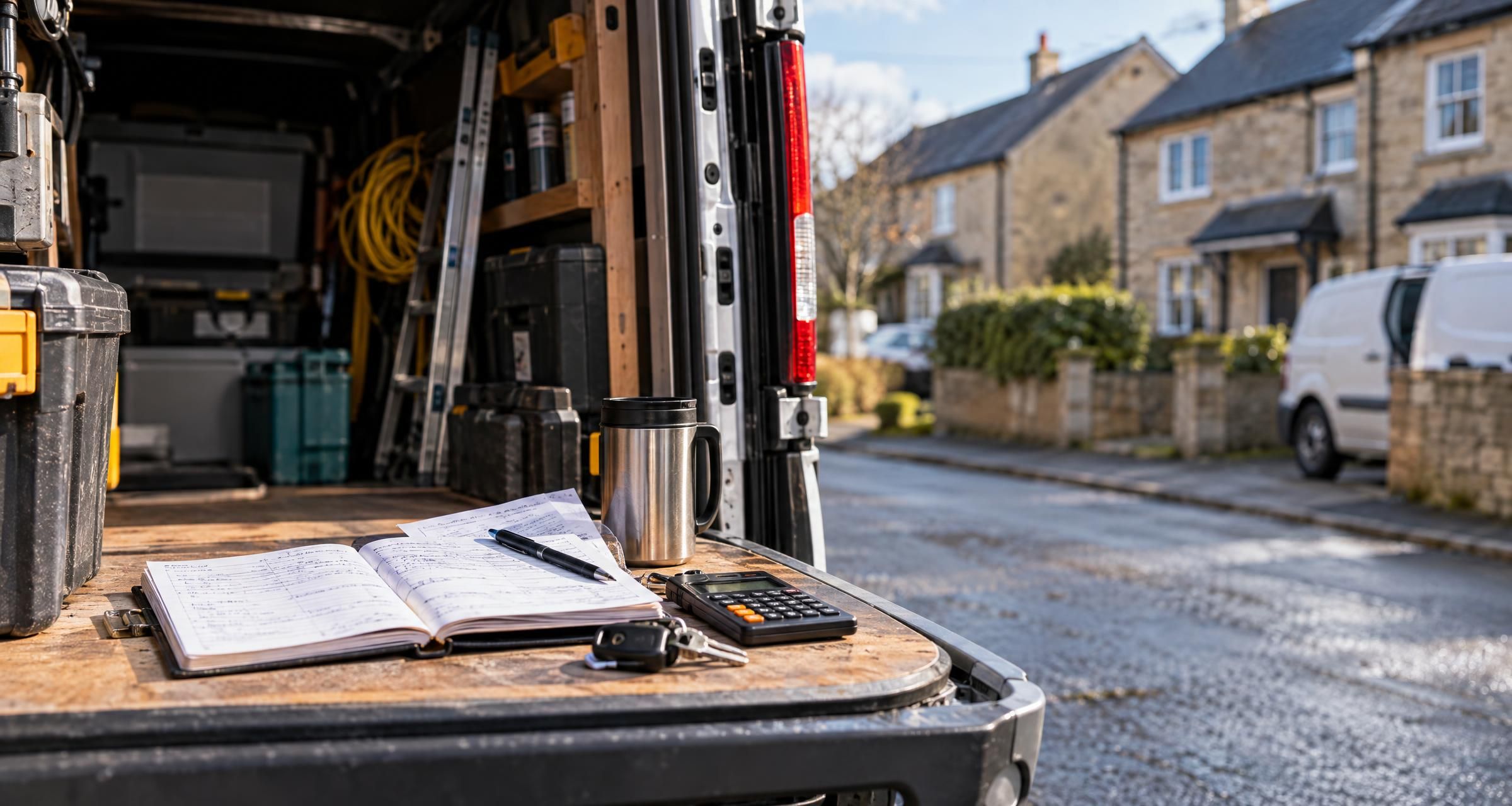
Can Tradespeople Claim Fuel and Mileage?
Can Tradespeople Claim Fuel and Mileage? Yes, in most cases, but the amount you can claim and the method you use depend on how your business is structured, who owns the vehicle, how it is used and whether you are VAT registered. Many sole traders either miss legitimate costs or claim too much without adequate records. Both mistakes cost money.
For a working tradesperson, the van or car is often one of the largest ongoing business costs after labour, materials and insurance. A typical week can include supplier runs, site visits, surveys, call outs, jobs across several postcodes and trips to dispose of waste. Fuel is only one part of that cost. Servicing, tyres, vehicle insurance, repairs, road tax, finance, parking and depreciation all affect what the vehicle really costs your business.
The sensible approach is to choose a tax method that suits your situation, record journeys properly and keep your business use clear. You should also price travel properly in customer quotes rather than treating tax relief as a substitute for recovering your costs.
Can Tradespeople Claim Fuel and Mileage? The short answer
Self employed tradespeople can usually claim tax relief for the business use of a vehicle. There are two main ways to do this:
- Claim mileage using HMRC approved mileage rates.
- Claim actual running costs, then work out the business proportion.
You cannot normally use both methods for the same vehicle in the same period. If you use mileage rates for a van or car, those rates are intended to cover fuel, servicing, repairs, insurance, tyres, road tax, depreciation and similar running costs. You may still be able to claim separate business costs such as parking fees, tolls and congestion charges, where they relate to allowable business travel.
For most sole traders using one vehicle for both work and private trips, mileage is often simpler. If you own a van used almost entirely for work and have significant operating costs, the actual cost method may produce a higher claim. The right answer depends on your records and the figures, not just what another tradesperson does.
HMRC explains the approved mileage allowance rules on its business travel and mileage guidance. Check the latest position before preparing your tax return, especially if your circumstances have changed.
What counts as business mileage for a tradesperson?
Business mileage is travel undertaken wholly and exclusively for your trade. For most tradespeople, this can include:
- Travel from your business base to a customer’s property.
- Travel between jobs on the same day.
- Trips to merchants to collect materials for a specific job or replenish normal stock.
- Travel to measure, quote, survey or inspect work.
- Travel to collect equipment, hire tools or take items for repair.
- Travel to your accountant, bank or other business appointment.
- Travel to dispose of legitimate business waste, provided the trip and disposal are handled lawfully.
- Travel to temporary training directly relevant to your trade.
The difficult area is travel from home. If your home is genuinely your business base, with administration, booking, quoting, records and work planning carried out there, journeys from home to changing customer sites may be business journeys. If you travel each day to one regular workplace, that may be ordinary commuting and is generally not allowable.
For example, a plumber who works from a home office, receives enquiries there, sends quotes there and travels to different customer addresses each day will usually have a stronger case for treating those journeys as business travel. A subcontractor who travels each weekday to the same building site for an extended period could be in a different position.
This is an area where details matter. Regular sites, long contracts, agency work and employment status can change the tax position. If you are unsure, speak to an accountant who works with construction and trades businesses before submitting your return.
Journeys that are usually private
Private mileage does not become allowable simply because you are driving a van, wearing work clothes or taking a phone call from a customer during the trip. Common private journeys include:
- School runs and family travel.
- Shopping that is not for business stock or materials.
- Holidays and social visits.
- Travel to a regular permanent workplace.
- Personal trips combined with a minor business errand where the main purpose is private.
Be realistic. A mileage log that shows a van travelling only for work every day of the year, with no private use, is likely to raise questions if that van is also used outside work.
The HMRC mileage rates explained
For cars and vans, the commonly used approved mileage allowance is:
| Vehicle type | Rate | How it applies |
|---|---|---|
| Cars and vans | 45p per mile | For the first 10,000 business miles in the tax year |
| Cars and vans | 25p per mile | For business miles above 10,000 in the tax year |
| Motorcycles | 24p per mile | For business mileage |
| Bicycles | 20p per mile | For business mileage |
For a sole trader, claiming 45p per mile does not mean HMRC sends you 45p for every mile. It means that amount is treated as an allowable business expense, reducing the profit on which you pay tax and, where relevant, National Insurance.
Suppose you drive 8,000 qualifying business miles in your van during the tax year. At 45p per mile, your allowable mileage expense would be £3,600. If you are taxed at a combined marginal rate of 28 per cent, the reduction in tax and National Insurance could be around £1,008. Your actual saving depends on your profit, tax position and other income.
The 45p rate is not designed to match the fuel cost alone. It is intended to account for the broader cost of using the vehicle. That is why you should not claim 45p per mile and then add the full cost of fuel, servicing and insurance for that same vehicle.
A practical mileage example
Consider a decorator using a personal car for mixed work and private travel. During one week, they drive:
- 24 miles to survey a kitchen repaint.
- 38 miles to a merchant and then to a customer job.
- 46 miles between two customer properties.
- 32 miles to collect a wallpaper order.
That is 140 business miles. At 45p per mile, the mileage claim is £63. The decorator should record the date, destinations, purpose and miles. A vague note saying “work travel” is not as useful as a proper record.
If the same car has already exceeded 10,000 business miles in that tax year, the rate for the 140 miles would be 25p, giving a £35 claim.
Mileage versus actual vehicle costs
The best method is the one that gives a fair and supportable claim without creating unnecessary administration. Before deciding, compare your likely business mileage claim with your actual annual vehicle costs.
| Method | Usually suits | What you need to keep | Main risk |
|---|---|---|---|
| Mileage allowance | Mixed use cars and vans, modest administration, clear mileage records | Date, journey, business purpose and miles | Claiming private or commuting miles |
| Actual costs | Vehicles with high operating costs or very high business use | All vehicle bills plus a record of business and private use | Claiming too much private use or losing receipts |
Using the mileage method
The mileage method is straightforward. You record business miles and multiply them by the relevant rate. It is particularly useful where you use the vehicle for personal trips as well as work.
Once you use simplified mileage for a vehicle, you usually need to continue using that approach for as long as you use that vehicle in the business. Do not switch methods each year simply because one produces a better answer. HMRC’s simplified expenses guidance for vehicles sets out the rules and examples.
Using actual costs
With the actual cost method, you add up vehicle expenses for the year and claim the business proportion. Costs may include:
- Fuel or electricity used for charging.
- Insurance.
- Repairs, servicing and MOT costs.
- Tyres, replacement bulbs and consumables.
- Vehicle excise duty.
- Breakdown cover.
- Lease payments, subject to the relevant rules.
- Interest on finance, but not repayments of the capital borrowed.
- Capital allowances for a vehicle you own, where applicable.
For example, a joiner has annual van costs of £7,200. A reliable mileage record shows that 85 per cent of the use is business related. The allowable running cost claim may be £6,120, subject to the treatment of finance and capital allowances. The remaining £1,080 is private and should not be claimed.
Actual costs can be worthwhile, but only if you maintain discipline. Keep invoices and receipts as you go. Do not wait until January and attempt to rebuild a year of fuel purchases from bank statements.
Which method may be better?
A small car doing 5,000 business miles could create a mileage claim of £2,250. If total annual vehicle costs are £4,000 but only half the use is business, actual costs would produce a £2,000 claim. Mileage would be better and simpler in that case.
A heavily equipped diesel van travelling 15,000 business miles could produce a mileage claim of £5,750: £4,500 for the first 10,000 miles and £1,250 for the remaining 5,000 miles. If actual eligible costs and capital allowance produce a larger legitimate claim, actual costs may be worth considering. A good accountant can run both calculations before you commit to a method.
Do not choose a method based only on fuel prices. Mileage covers far more than what you spend at the pump.
Fuel receipts, mileage logs and records that stand up
Good records protect your claim and help you understand whether jobs are actually profitable. HMRC expects self employed people to keep records of business income and expenses. You can read its guidance on keeping records for self employment.
A mileage record can be kept in a notebook, spreadsheet, accounting app or mileage app. The format matters less than accuracy and consistency.
What to record for every business journey
- Date of travel.
- Vehicle registration or a clear identification of the vehicle.
- Start and finish locations.
- Customer, site or supplier name where relevant.
- Business reason for the journey.
- Miles travelled.
- Odometer reading where practical, especially at the start and end of the tax year.
A useful habit is to log journeys before leaving site or while parked at the merchant. If you leave it until the weekend, you will forget detours, extra visits and whether a journey was private or business.
For actual cost claims, retain fuel receipts, garage invoices, insurance documents, lease statements and finance paperwork. A bank statement can show that you paid a garage, but it may not explain what work was done or whether it related to your business vehicle.
Use job records to support mileage
Your diary, quotes, invoices and job scheduling system should broadly match your mileage log. If an invoice shows you installed a bathroom in Leeds on Tuesday, a mileage entry for the return journey is easy to understand. If you claim a long journey but have no quote, invoice, supplier receipt or diary entry around that date, it becomes harder to support.
This is also commercially useful. Your records can show which areas are costing too much in travel and which types of jobs create repeated unpaid visits.
Do not confuse tax relief with charging customers for travel
A tax deduction does not reimburse your business in full. It only reduces the profit on which tax is charged. If a job requires a 50 mile round trip, two merchant runs and a return visit, those costs need to be reflected in your pricing.
Take a simple example. A 60 mile round trip in a van may cost roughly £12 to £18 in fuel depending on the vehicle and fuel price. But the true cost includes tyre wear, servicing, depreciation, insurance and your unpaid driving time. At the 45p mileage rate, the recognised cost is £27.
If driving, loading and unloading adds two hours to a small job, the bigger cost may be lost earning time. A tradesperson who normally bills £45 per hour has potentially given away £90 of productive time before considering vehicle cost.
You do not need to present every customer with a mileage calculation. Instead, build travel into your call out charge, survey fee, day rate, minimum job value or geographic service area. Be clear in advance where a charge applies.
Practical ways to recover travel costs
- Set a minimum charge for small repairs.
- Use a call out fee that covers travel and initial diagnosis.
- Quote fixed prices that include normal local travel.
- Apply a clearly stated travel charge outside your usual area.
- Group surveys and material collections by area on the same day.
- Charge separately for additional visits caused by customer changes or delayed access.
This protects margin without making every estimate look complicated. It also stops profitable looking small jobs becoming loss makers once the time in the van is counted.
VAT, fuel and private use
If you are VAT registered, fuel creates additional record keeping issues. You may be able to reclaim input VAT on fuel bought for business use, provided you hold valid VAT evidence and meet the usual rules. However, private use needs to be dealt with correctly.
Some businesses reclaim VAT on all road fuel and apply the fuel scale charge to account for private use. Others reclaim VAT only on the fuel used for business journeys. The better approach depends on the vehicle, mileage, private use and quality of records.
The rules are not something to guess at. HMRC publishes detailed guidance in VAT Notice 700/19 on fuel and power. Ask your accountant to assess your approach before your next VAT return if you have not already done so.
Remember that claiming a business expense for income tax and reclaiming VAT are separate calculations. A cost can be allowable for income tax while the VAT treatment requires a different adjustment.
Limited companies, directors and employee mileage
If you trade through a limited company and use your own personal vehicle for company journeys, the company can generally reimburse you at approved mileage rates. The company treats the payment as an expense, and payments within the approved rates are normally not taxed as earnings.
You should submit a mileage claim to the company with the same supporting information: date, journey, business purpose and miles. Paying yourself a round sum each month without mileage evidence is poor practice and can create problems if records are reviewed.
If the company owns the vehicle, the position is different. Fuel, maintenance and other costs are company expenses, but personal availability and private fuel can create benefit and tax issues. A company van with restricted private use may be treated differently from a company car that is freely available for personal journeys.
This is where a small amount of professional advice can save a much larger bill. The choice between a personal vehicle and company vehicle affects tax, VAT, insurance, finance, cash flow and resale value.
Costs that are often missed or wrongly claimed
Fuel is the obvious cost, but it is rarely the only travel related expense. Review your records for legitimate costs that may have been missed:
- Business parking charges.
- Tolls and congestion charges for business journeys.
- Train fares or public transport for business appointments.
- Accommodation for qualifying overnight business travel.
- Necessary subsistence during qualifying business travel, within the relevant rules.
- Merchant delivery charges where they relate to a customer job.
- Vehicle cleaning where it is genuinely required for business use.
Parking fines, speeding penalties and other fines are not allowable business expenses. Neither is the cost of a personal meal simply because you are working away from home for the day. The distinction is whether the expense arises because of the business journey, rather than ordinary personal living costs.
Be careful with mixed purchases. A fuel receipt may cover a full tank, but if the vehicle is used privately, you need a fair basis for separating business use when claiming actual costs.
Common mistakes that cost tradespeople money
Claiming fuel and 45p mileage for the same vehicle
This is one of the clearest errors. The mileage rate already includes fuel and normal vehicle running costs. Choose the method that applies to that vehicle and keep to it.
Not recording mileage until tax return time
Reconstructing a year from old invoices is slow and unreliable. You may underclaim because you forget journeys, or overclaim because estimates become too generous. Record travel weekly at the latest.
Including commuting as business mileage
Travel to a regular place of work is not automatically allowable because you are self employed. Review whether your home is truly a business base and whether sites are temporary or regular.
Using a single percentage without evidence
Claiming that a van is “about 90 per cent business” is weak if there is no mileage log or other support. A short period of careful tracking can provide a much stronger basis for your estimate.
Forgetting the cost of time on the road
Tax claims are backward looking. Pricing is forward looking. If you win work too far from your usual patch without adjusting your price, travel can reduce your effective hourly rate sharply.
How local job selection can reduce vehicle costs
Winning more work does not always mean travelling further. A well planned diary with jobs in the same area can reduce miles, fuel spend and dead time while giving customers faster appointment options.
Set realistic service areas based on your trade, job value and average journey time. An electrician carrying out quick fault finding visits may need a tighter radius than a builder quoting larger renovation projects. For bigger jobs, a longer journey may be viable if the margin, duration and likelihood of additional work justify it.
Platforms that help you get in front of homeowners can form part of this strategy if you use them selectively. BookaBuilderUK can help tradespeople create opportunities with homeowners looking for work, but you should still assess each enquiry on location, job scope, access, materials, payment terms and expected margin before committing time to quote.
For more practical ideas on choosing work in your area, read How to Get More Local Jobs as a Tradesperson in 2025. The aim is not simply a fuller diary. It is a diary with enough profitable work to cover travel, administration and the inevitable gaps between jobs.
A seven day action plan to improve your mileage claims
- Choose your tracking method. Use a notebook, spreadsheet or app that you will actually update.
- Photograph your odometer. Take a clear image at the start of your tracking period.
- Log every work journey for seven days. Include supplier visits and quoting appointments, not only paid jobs.
- Collect all vehicle documents. Put fuel receipts, insurance, servicing invoices, MOT paperwork and finance documents in one place.
- Review your travel area. Identify repeated long trips, unpaid surveys and unprofitable small jobs.
- Check your quote terms. Add or tighten a minimum charge, call out fee or travel policy where needed.
- Speak to your accountant. Ask whether mileage or actual costs is best for each business vehicle before your year end.
After one month, total your business miles and compare them with the revenue generated by each area and job type. You may find that a customer cluster ten miles away is profitable because jobs are grouped, while a supposedly local area is causing repeated low value visits.
Vehicle decisions that affect future claims
The way you buy, lease or finance a vehicle affects your records and tax treatment. A cheap used van may keep monthly payments low but create repair downtime. A newer vehicle may be more reliable but tie up cash in finance and insurance. Neither decision should be made on tax relief alone.
Keep vehicle costs separate from job costs in your accounts where possible. You need to know whether a poor month was caused by lower sales, material overspend, unpaid time, vehicle repairs or too much travel. That clarity makes pricing decisions much easier.
FAQ
Can Tradespeople Claim Fuel and Mileage at the same time?
Usually, no. If you claim the approved mileage rate for a vehicle, that rate is intended to cover fuel and normal running costs such as insurance, repairs, servicing and depreciation. You may normally claim separate business parking, tolls and congestion charges where relevant. If you use the actual cost method instead, you can claim the business proportion of fuel and other vehicle expenses, but you need receipts and a reasonable record of private use.
How much mileage can a self employed tradesperson claim?
For cars and vans, the approved mileage rate is generally 45p per business mile for the first 10,000 miles in the tax year and 25p per mile after that. There is no fixed cap on the number of legitimate business miles you can claim, but every journey must be allowable and supported by records.
Can I claim mileage from home to a customer?
You may be able to if home is genuinely your business base and you travel to different customer sites. If you travel from home to one regular workplace, the journey may be treated as ordinary commuting and may not be allowable. This distinction can be complicated for long running sites and subcontract work, so obtain advice if a large part of your claim depends on it.
Do I need fuel receipts if I claim mileage?
You do not normally need fuel receipts to support a mileage allowance claim, because you are claiming based on business miles rather than the amount spent on fuel. You do need an accurate mileage record that shows the date, journey, business purpose and miles. Keeping fuel receipts is still sensible for monitoring cash flow and vehicle costs.
Can I claim parking and tolls on top of mileage?
Business parking fees, road tolls and congestion charges can usually be claimed separately from mileage where they relate to an allowable business journey. Parking fines and other penalties cannot be claimed. Keep the receipt or digital confirmation and link it to the relevant job where possible.
Final Thoughts
Fuel and mileage claims are not difficult once you separate business journeys from private travel, choose one consistent method for each vehicle and maintain records as you work. The bigger opportunity is using those records to price travel properly, reduce wasted miles and protect the margin on every job.
To create more opportunities with homeowners looking for trade work, visit BookaBuilderUK.


