
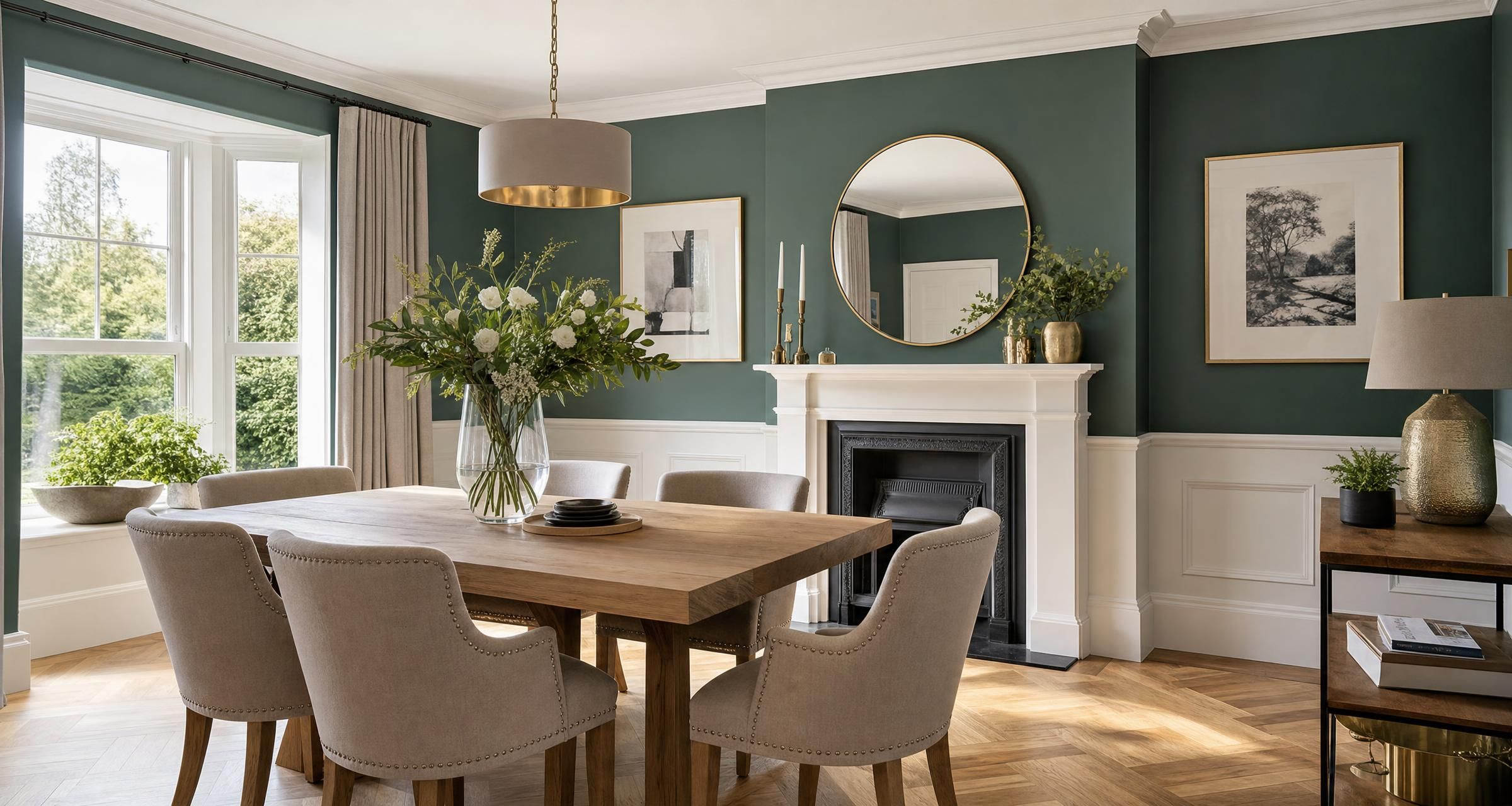
Dining Room Paint Ideas
Well chosen dining room paint ideas can make an overlooked room feel warmer, brighter, more formal or more relaxed, without the cost of replacing furniture or altering the layout. The right colour needs to work in daylight, artificial light and candlelight, while also standing up to chair backs, fingerprints, food splashes and regular cleaning.
In practical terms, a dining room is often one of the most changeable spaces in the house. It may be used for family meals, homework, entertaining, working from home or occasional celebrations. That means the paint scheme should suit how the room is genuinely used, rather than simply copying a colour seen online.
A professional decorator will usually assess the room’s aspect, window size, existing flooring, joinery, ceiling height and lighting before recommending colours. These details determine whether a pale shade feels fresh or cold, and whether a deep tone feels intimate or oppressive.
Start with the room’s natural light
The direction your dining room faces has a major effect on paint colour. A tester card viewed beside a window at midday can look entirely different at breakfast, late afternoon and under pendant lights in the evening.
| Room aspect | Typical light quality | Paint colours that often work well | Colours to test carefully |
|---|---|---|---|
| North facing | Cooler light, often slightly grey | Warm whites, clay, muted ochre, warm olive, soft terracotta, deep blue green | Blue grey, stark white, cool lilac, very pale green |
| South facing | Strong warm daylight | Soft grey, chalky blue, sage, dusty pink, warm stone, richer greens | Overly yellow cream, very bright orange, highly reflective white |
| East facing | Bright morning light, lower light later | Warm neutrals, muted blush, olive, soft grey green, pale mushroom | Very cold grey, icy blue, flat beige |
| West facing | Lower light in the morning, warm evening sun | Warm white, greige, soft blue, charcoal, deep red brown, forest green | Strong yellow, intense orange, very pale cool tones |
Test colours on painted sample boards rather than directly on every wall. Move the boards around the room and assess them in the morning, afternoon and evening. A good sized test area is at least 500mm square. Tiny tester patches rarely provide a reliable impression because surrounding colours dominate the eye.
If your dining room is connected to a kitchen, hallway or living room, consider sight lines as well. The colours do not need to match, but they should feel intentional together. A warm off white in the hall can sit comfortably beside a muted green dining room, while a strong blue grey hallway beside a yellow based cream dining room can look disjointed.
Dining room paint ideas for different styles of home
Warm neutral dining rooms
Warm neutrals remain one of the safest options for UK dining rooms, particularly in Victorian terraces, semi detached houses and newer homes with limited natural light. Think soft mushroom, putty, oat, stone, biscuit and gentle taupe rather than magnolia.
These shades work well with oak, walnut, black furniture, brass fittings and natural linen curtains. They also provide a forgiving background for changing artwork, tableware and seasonal decorations. Use a deeper version of the wall colour on a chimney breast or built in shelving for a layered finish.
A warm neutral is especially useful where dining furniture is mismatched. Rather than making the room look untidy, a calm wall colour brings different timber tones and upholstered chairs together.
Deep green walls for an intimate dining room
Deep green is a strong choice for rooms used mainly in the evening. Forest green, olive, moss and blue green shades can make a dining room feel settled and elegant, particularly with timber flooring, period cornicing or a painted fireplace.
Do not assume dark paint is only suitable for large rooms. A compact dining room can look more purposeful in a rich colour, provided the lighting is planned properly. Use warm white lamps, a pendant above the table and wall lights where possible. A single central ceiling fitting is rarely enough for a dark scheme.
For more ideas on pairing rich paint colours with practical storage and softer illumination, read Moody Dining Room Ideas for Homes Soft Lighting Wall Colours and Built In Storage.
Blue dining room paint ideas
Blue can be calm, formal or dramatic depending on the undertone. A dusty blue works well in period homes and rooms with plenty of daylight. Mid tone teal can suit contemporary spaces with dark timber and brushed brass. Navy gives a more formal effect, especially on panelling, lower walls or a single focal wall.
In north facing dining rooms, test blue with care. A shade that appears refined in a south facing showroom may turn cold and flat at home. Paint a large board and view it next to white crockery, a timber table and your curtains. These familiar materials reveal undertones quickly.
Terracotta, clay and earthy red tones
Earth based shades are increasingly popular because they add warmth without looking overly traditional. Muted terracotta, brick, russet, clay and cinnamon shades are particularly effective in dining rooms with timber furniture, natural stone floors or black framed glazing.
The best versions are usually softened with brown, pink or grey pigment. Bright orange or vivid red can dominate a dining room and may be difficult to live with long term. If you like stronger colour but want a less permanent commitment, use it on a chimney breast, picture rail section or alcove wall.
Soft pink, plaster and dusky rose
Muted pink has moved well beyond children’s bedrooms. A dusty rose, plaster pink or warm blush can make a dining room feel comfortable and flattering under evening lighting. It works particularly well with dark wood, antique furniture, aged brass and off white ceilings.
Avoid cool candy pinks unless the room receives plenty of warm natural light. Most homeowners are better served by a brown based or grey based pink that reads as a neutral at certain times of day.
Black, charcoal and dark brown
Charcoal, nearly black and deep brown dining rooms can look excellent in houses with high ceilings, substantial windows and architectural features. They suit formal dining rooms, converted loft spaces and modern extensions with generous glazing.
These tones need careful preparation because light catches every roller mark, filled crack and uneven patch. Use a quality acrylic eggshell or durable matt paint, not a cheap contract emulsion. Consider painting skirting boards, architraves and doors in the same tonal family for a more cohesive finish.
Choose the right finish for dining room walls and woodwork
Colour gets most of the attention, but paint finish determines how practical the room will be. Dining rooms need surfaces that can tolerate occasional wiping, especially around the table, light switches and door openings.
For most walls, a washable durable matt emulsion is the sensible choice. It gives the low sheen appearance homeowners often want, while being more resistant to scuffs than basic matt paint. In households with young children or frequent entertaining, a scrubbable matt product is worth the extra cost.
Ceilings normally suit a flat matt ceiling paint, which helps conceal minor surface variations. For skirting boards, doors, window boards and built in units, water based satin or eggshell is practical and dries faster than traditional oil based gloss.
The choice depends on the substrate as well as the look you want. Our guide to Choosing the Right Paint Finish for Different Surfaces explains where matt, eggshell, satin and gloss finishes are best used around the home.
| Surface | Recommended finish | Why it works | Typical paint cost |
|---|---|---|---|
| Dining room walls | Durable matt or scrubbable matt | Low sheen appearance with better resistance to marks and light cleaning | £35 to £75 for 2.5 litres |
| Ceiling | Flat matt ceiling paint | Helps disguise minor ripples and patch repairs | £20 to £45 for 2.5 litres |
| Skirting boards and architraves | Water based satin or eggshell | Hard wearing and easier to clean than matt | £25 to £55 for 2.5 litres |
| Internal doors | Water based satin, eggshell or gloss | Suitable for frequent handling and cleaning | £25 to £60 for 2.5 litres |
| Panelling and fitted cabinetry | Water based eggshell or specialist furniture paint | Provides a durable finish without excessive shine | £30 to £70 for 2.5 litres |
Coverage figures on tins are useful but optimistic if walls are porous, textured or being changed from dark to light. Most quality emulsions cover around 10 to 14 square metres per litre per coat. A typical dining room may require 5 to 10 litres for two coats on walls, depending on size and colour change.
Use paint to improve the proportions of the room
Paint can alter how a room feels, although it cannot correct structural problems or poor layout. Used well, colour can make ceilings seem lower, walls appear wider and awkward alcoves feel deliberate.
Make a narrow dining room feel wider
Keep the longer walls in a lighter shade and use a slightly deeper colour on the shorter end wall. This draws the eye forward and can reduce the corridor effect. Avoid placing a very dark colour on both long walls in a narrow room unless you want a deliberately cocooning look.
Make a high ceiling feel more connected
Painting the ceiling a soft stone, pale clay or diluted version of the wall colour can reduce the contrast between walls and ceiling. In period homes with ceiling roses and cornices, a coloured ceiling can look particularly effective.
Keep the colour light enough to retain brightness. A ceiling in a deep shade may work in a large formal dining room, but it can feel heavy in a standard 2.3 metre ceiling height.
Use a darker lower wall
A darker paint below a dado rail, real or painted, is practical in family dining rooms. It disguises chair marks and scuffs while giving the room visual structure. The upper wall can be a lighter related shade to maintain a sense of height.
Measure carefully before applying a painted division. A line placed too high or too low can make the room look awkward. In many rooms, positioning it around 900mm to 1,100mm from the finished floor works, but it should relate to window sills, furniture height and any existing joinery.
Highlight architectural features
Alcoves, chimney breasts, picture rails, panel mouldings and built in bookcases are useful opportunities for colour. A deeper shade in an alcove behind a sideboard can create a focal point without painting every wall dark.
If you are fitting new decorative wall mouldings, allow for proper preparation. MDF mouldings need sealing on cut edges, careful caulking and priming where required. Poorly fixed panels can open at joints as timber and plaster move through seasonal temperature changes.
Coordinate paint with dining room lighting
Lighting can either support your colour scheme or completely undermine it. A warm terracotta wall can look rich under a 2700K lamp, yet dull or muddy under a cool 4000K lamp. For dining spaces, warm white light between 2200K and 3000K is normally the most comfortable choice.
A pendant over the dining table should generally sit around 750mm to 900mm above the tabletop, depending on the fitting size and ceiling height. This gives useful light without blocking sight lines. Add dimming where possible, especially if the room is used for both everyday meals and entertaining.
Any new fixed electrical work should be carried out safely by a competent electrician. Some work in dwellings is notifiable under Part P of the Building Regulations, particularly where circuits are altered or new circuits are installed. Homeowners can check the current position through the government guidance on electrical safety in dwellings.
Use an electrician registered with a recognised competent person scheme where appropriate. Ask for certification after the work, particularly if new circuits, consumer unit alterations or substantial changes have been made. For design ideas that pair paint with practical layered illumination, see Dining Room Lighting Ideas.
How much does it cost to paint a dining room in the UK?
The cost of painting a dining room depends less on the final colour and more on preparation. A straightforward room with sound walls, empty furniture and a simple two coat finish is relatively quick. Old wallpaper, nicotine staining, cracked plaster, water damage, elaborate woodwork and dark colour changes all add labour and materials.
| Type of work | Typical UK price range | Typical timeframe |
|---|---|---|
| Paint walls only in a small dining room | £250 to £450 | 1 to 2 days |
| Walls and ceiling in an average dining room | £400 to £750 | 2 to 3 days |
| Walls, ceiling, skirting boards, door and window trims | £650 to £1,200 | 3 to 5 days |
| Strip wallpaper, repair surfaces and fully redecorate | £1,000 to £2,000 or more | 5 to 8 days |
| Install and paint decorative wall panelling | £500 to £1,500 or more | 2 to 5 days |
These figures are broad guide prices for 2026 and can be higher in London and the South East. They normally include standard materials and labour, but not extensive plastering, major carpentry repairs, wallpaper supply, specialist finishes or electrical alterations.
Decorator day rates commonly range from £180 to £300 per day outside London, and around £250 to £400 per day in London, depending on experience, demand and project complexity. Obtain written quotes that state whether paint is included, how many coats are allowed for, what preparation is covered and whether furniture moving is included.
Practical preparation checklist before painting
- Remove pictures, mirrors, curtain poles, shelves and wall fixings where practical.
- Move furniture to the centre of the room or into another room, then protect it with clean dust sheets.
- Wash greasy marks and handprints with sugar soap or a suitable degreaser, then allow surfaces to dry fully.
- Scrape loose paint and check for cracks, blown plaster or damp staining.
- Fill small dents with suitable filler, allow it to dry, sand smooth and remove all dust.
- Seal bare filler and porous plaster before applying finish coats.
- Use stain block on nicotine, water marks or tannin bleed before decorating.
- Mask carefully around sockets, switches, flooring and trim, but do not rely on tape to hide poor cutting in.
- Stir paint thoroughly and use the same batch number for each wall colour where possible.
- Allow proper drying time between coats, following the manufacturer’s instructions.
Do not paint over active damp, mould or a fresh water leak. The cause must be identified first. A stain blocked and repainted patch may look fine briefly, then discolour again within weeks. Check gutters, external brickwork, roof defects, plumbing leaks and ventilation before redecorating.
Older properties need extra care. If you suspect lead paint beneath existing coatings, avoid dry sanding or using a heat gun without appropriate controls. The Health and Safety Executive provides guidance on working safely with lead. If textured coatings, insulation boards or old pipe lagging are disturbed during wider refurbishment, consider the possibility of asbestos and obtain professional advice before starting work.
Common mistakes to avoid with dining room paint ideas
Choosing colour from a phone screen
Digital images vary significantly between screens and lighting conditions. A colour can look muted online but far stronger on a large wall. Always buy tester pots or sample sheets and assess them in your own room.
Using brilliant white everywhere
Pure white can work in a bright contemporary extension, but in many UK dining rooms it appears cold, especially under cool LED lamps. Off whites with a subtle warm undertone are usually easier to live with and better at disguising minor wall imperfections.
Ignoring the existing floor and furniture
A paint colour cannot be selected in isolation. Orange toned oak flooring can clash with some pink or yellow based neutrals. Grey laminate can make warm cream walls look dirtier than expected. Test your paint alongside flooring, curtains, dining chairs and timber finishes.
Applying dark paint without enough preparation
Dark colours expose poor filling, roller overlap and uneven absorption. Walls should be smooth, properly primed where necessary and painted in a consistent sequence, maintaining a wet edge. Cheap rollers shed fibres and create a rough finish that is highly visible under pendant lighting.
Using the wrong paint finish near the table
Basic contract matt paint marks easily and can burnish when wiped. For a dining room that gets regular use, spend more on durable matt paint. The additional cost of a better product is usually small compared with paying for the room to be repainted early.
Painting before electrical or carpentry work is complete
Plan the order of work. New sockets, wall lights, panelling, shelving and radiator changes should usually be completed before final decoration. Otherwise, newly finished walls may need filling, sanding and repainting around fresh work.
Create a cohesive scheme with adjacent rooms
Dining rooms rarely exist as isolated spaces. In open plan homes, paint needs to define zones without making the interior feel chopped up. One useful approach is to use a shared neutral on ceilings, trim and connecting walls, then introduce a deeper dining room colour on the main walls.
In homes with separate rooms, repetition can be more subtle. Use the same finish on all internal woodwork, repeat a metal finish in lighting and door furniture, or pick colours with similar undertones. For example, a warm grey hallway can lead into a muted olive dining room, while a pale clay kitchen can sit comfortably beside a deep terracotta dining room.
If you want the dining room to feel more inviting, combine paint with texture. Linen curtains, woven blinds, timber furniture, a wool rug and shaded lamps all soften hard surfaces. For further inspiration, read Cosy Dining Room Ideas for Homes with Layered Lighting and Textured Finishes.
Frequently asked questions
What is the best paint colour for a small dining room?
There is no single best colour, but soft warm neutrals, muted greens, dusty blues and plaster pinks are reliable starting points. A small dining room does not have to be painted white. Richer colours can make a compact room feel more intentional and comfortable, especially if it is mainly used in the evening. The deciding factors are natural light, ceiling height, furniture and the lighting plan.
Should a dining room be painted in matt or silk paint?
For most homes, durable matt is the better choice. It provides a softer finish than silk and hides minor wall imperfections more effectively. Modern washable matt paints are practical for dining rooms, provided spills and marks are cleaned gently. Silk paint has a higher sheen, which can highlight roller marks, uneven plaster and repaired areas.
Can I paint my dining room myself?
Yes, a straightforward room can be a realistic DIY job if the walls are in good condition and you allow enough time. Expect a weekend for walls and ceiling in a small room, plus longer if woodwork is included. Preparation often takes as long as painting. If there is damaged plaster, old wallpaper, stains, high ceilings, extensive woodwork or a dark colour scheme, hiring a decorator often produces a better long term result.
Do I need planning permission to redecorate a dining room?
Internal painting and ordinary redecoration do not normally need planning permission or Building Regulations approval. Different rules may apply to listed buildings, particularly where work affects historic fabric, decorative plasterwork, original panelling or protected finishes. Check with your local planning authority before making alterations to a listed property.
How long should I wait before putting furniture back after painting?
Most water based wall paints are touch dry within a few hours, but they need longer to harden. Leave the room well ventilated and avoid pushing furniture tightly against freshly painted walls for at least 24 to 48 hours. Full curing can take several days or longer, depending on the product, room temperature and humidity. Follow the drying and curing guidance on the paint tin.
Final Thoughts
The best dining room paint ideas balance appearance with everyday use. Start with the light, test colours at different times of day, choose a finish that can be cleaned and spend time on preparation. A well painted dining room should look considered in daylight, comfortable in the evening and robust enough for real family life.
For help with preparation, decorating, panelling, plaster repairs or lighting alterations, post a job on BookaBuilderUK to get free quotes from vetted local tradespeople.


