
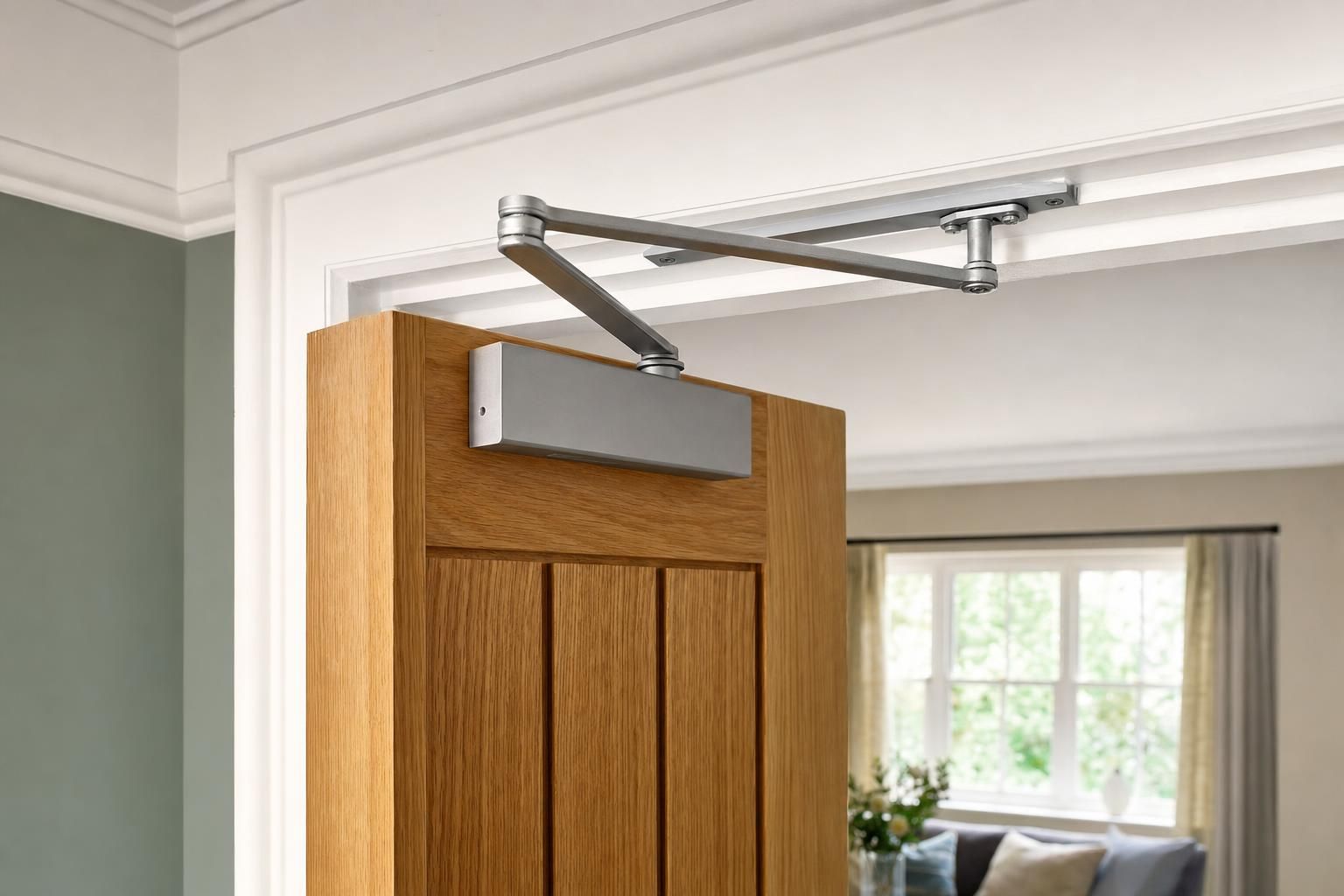
How To Fit a Door Closer
Learning how to fit a door closer properly is useful for homeowners improving safety, controlling a busy internal door or working on a fire door that is required to self close. A door closer controls the closing action of a door, bringing it back to the frame at a measured speed and, where required, latching it shut. The job looks simple from the outside, but poor positioning, excessive closing force or unsuitable fixings can leave a door difficult to use or unable to perform its intended fire safety function.
Approved Document B commonly exempts internal fire doors within an individual dwellinghouse from self closing devices. This generally includes doors opening onto a protected stair in a loft conversion or three storey house. Different requirements can apply to doors between an integral garage and a dwelling, flat entrance doors and certain fire doors in communal or managed buildings. Homeowners should confirm the requirement with Building Control or the building’s fire risk assessor before fitting, removing or replacing a closer.
For a standard internal non fire door, fitting a basic overhead door closer is often a manageable DIY task if the door and frame are sound. Where a fire door is required to self close, the closer must be suitable for the door rating, fitted in line with its fire test evidence, and adjusted so that the latch engages fully. A fire door that is meant to self close but does not close and latch cannot be relied upon to contain fire and smoke.
A competent carpenter, fire door installer or locksmith will normally fit and adjust a straightforward closer in around one to two hours. Costs for a professional installation commonly range from £80 to £180 for labour, plus the closer itself. Fire door work can cost more where the door needs adjustment, certified ironmongery is required, or several doors need inspecting and upgrading.
What does a door closer do?
A door closer is a mechanical or electromechanical device that returns a hinged door to its closed position after someone has passed through it. Most domestic and commercial closers use a spring and hydraulic oil chamber. The spring pushes the door shut and the hydraulic control regulates the speed.
The closer normally controls two stages of movement. The first is the sweep speed, which governs most of the door travel. The second is the latch action, which gives the door enough force in the final few degrees to overcome the latch and engage it with the strike plate.
Many closers also include backcheck. This resists the door being thrown open too quickly, helping to protect walls, hinges and the closer arm. Backcheck is not a door stop. A separate stop should be fitted where the door could hit a wall, radiator or furniture.
Closers are commonly fitted to flat entrance doors, doors between integral garages and dwellings, and certain fire doors in communal or managed buildings. Internal doors opening onto protected stairways within individual dwellinghouses do not generally require self closing devices under Approved Document B. Closers are also useful on utility rooms, home offices, workshops and doors that need to remain closed for privacy or draught control.
When you need a door closer in a UK home
A closer is not required on every internal door in an ordinary house. Most bedroom, living room and bathroom doors can be manually closed unless the property design, fire strategy or insurance requirements say otherwise.
Approved Document B states that fire doors within dwellinghouses are generally not required to be fitted with self closing devices. This exemption commonly applies to internal fire doors opening onto the protected stairway in a loft conversion or three storey house. Those doors may still need the specified fire resistance, suitable hinges, intumescent protection and, where required by the approved design, smoke seals.
A notable exception is a fire door between an integral garage and the dwelling, which should be fitted with a self closing device. Flat entrance doors also require reliable self closing because they protect the common escape route. Certain doors in communal areas, houses in multiple occupation and other managed residential buildings may need closers under the building’s fire strategy and fire risk assessment.
For new building work and material alterations, the relevant guidance is generally found in Approved Document B, Fire Safety. Building Regulations guidance is not a substitute for a project specific assessment. Building Control should confirm the requirements for a loft conversion, extension or other controlled work. In a shared or managed building, consult the responsible person, managing agent or fire risk assessor before altering fire door hardware.
For a fire door that requires a closer, do not select one based only on appearance or price. The closer must be compatible with the fire door assembly. That includes the leaf, frame or lining, hinges, locks, latches, seals and glazing where present. Read our guide to Fire Rated Doors in UK Homes Explained When You Need Them, FD30 vs FD60 Ratings and Key Installation Rules before buying hardware for a fire resisting door.
Types of door closer and where each works best
| Type of closer | Typical UK supply cost | Best use | Points to consider |
|---|---|---|---|
| Overhead rack and pinion closer | £25 to £120 | Most internal doors, fire doors and communal doors | Robust and adjustable. The closer body remains visible. |
| Cam action overhead closer | £90 to £250 | Fire doors needing lower opening resistance | Often easier for children and people with reduced strength. Usually costs more. |
| Concealed jamb or transom closer | £100 to £350 | Higher specification interiors | Needs accurate routing or frame preparation. Check fire test evidence. |
| Floor spring | £180 to £500 | Heavy doors, glass doors and commercial entrances | Requires floor work and careful alignment. Rarely worthwhile for a standard house door. |
| Electromagnetic hold open closer | £150 to £500 or more | Fire doors that need to stay open in normal use | Must release on fire alarm activation. Never wedge a fire door open. |
The most common choice for a house is an overhead rack and pinion unit, sometimes called a surface mounted closer. It can be fitted with the body on the door and the arm on the frame, or in a parallel arm arrangement where the arm sits closer to the door face. Always follow the specific template supplied by the manufacturer. Dimensions vary between models.
For a fire door, look for a closer tested to the appropriate fire performance standard, commonly BS EN 1154 for controlled door closing devices. The product should carry suitable evidence for the intended fire rating and installation arrangement. If the closer has a hold open feature, it must not be a simple friction hold open device on a fire door. Fire doors need an approved automatic release arrangement where they are intended to stand open.
Before you fit a door closer, inspect the door and frame
A closer cannot compensate for a badly hung door. Check the door before drilling a single hole. Open it fully and let it rest at several positions. It should not swing freely because it is out of plumb, scrape on the floor, bind against the frame or catch on carpet.
Check that the hinges are secure and free from excessive movement. Loose hinge screws are particularly common in hollow core doors and softwood linings. If the screws turn without tightening, repair the fixing before fitting the closer. Larger screws, timber plugs or a suitable repair method may be needed, depending on the construction.
The latch must engage properly with the keep. A closer will expose small alignment faults that a person can normally overcome by pushing the door. If the latch is rubbing the strike plate, adjust the keep first. Do not turn up the closer power simply to force a poor latch alignment.
The supporting structure matters too. A lining is normally used for many internal doors in stud partitions, while a more substantial frame may be fitted in masonry openings or external locations. The terminology and construction are explained in Door Lining vs Door Frame Explained for Homeowners and When Each Is Used. A closer arm fixed into weak, split or poorly packed timber will soon work loose.
Practical pre installation checklist
- Confirm whether the door is a fire door and identify its required rating.
- Confirm whether the fire strategy or approved design requires a self closing device.
- Check the closer is suitable for the door width, weight and fire rating.
- Read the manufacturer template and instructions before marking holes.
- Make sure the door opens and closes freely without the closer fitted.
- Check hinge screws, latch alignment and the condition of the frame or lining.
- Measure the door width and confirm the closer power size is adequate.
- Identify whether the closer body is fitted to the pull side or push side.
- Use a door stop where the open door could strike a wall or obstruction.
- For fire doors, confirm intumescent seals, hinges and latch are also suitable.
- Keep the closer instructions and fire test information with your property records.
Tools and materials needed to fit a door closer
Most surface mounted closers can be fitted with ordinary carpentry tools. You will usually need a tape measure, pencil, combination square, drill, drill bits, bradawl, pozi or Phillips screwdriver, adjustable spanner and safety glasses. A cordless drill with adjustable clutch is useful, but do not rely on it for final tightening because it is easy to strip screws in softwood.
The closer pack should include a paper template, fixing screws, arm components and adjustment information. On a fire door, use only the supplied or manufacturer approved fixings. Substituting short screws or generic fixings can undermine the tested assembly.
Door hinges must also be capable of carrying the extra load created by the closer. A typical solid core FD30 door often needs three suitable fire rated hinges. Read Door Hinge Types Explained if you are assessing whether existing hinges are suitable.
How to fit a door closer step by step
1. Choose the mounting arrangement
Most closers offer several mounting options. The standard arrangement generally places the closer body on the pull side of the door, with the shoe fixed to the frame head. Parallel arm fitting generally places the closer body on the push side, with the arm folded more neatly against the door.
The opening angle available can change between arrangements. Before choosing, check for nearby walls, cupboards, radiators and architraves. A closer that is fitted correctly but restricted to a narrow opening may make a room awkward to use.
2. Position the manufacturer template accurately
Close the door and place the paper template exactly where the instructions show. Templates commonly align with the hinge edge, top of the door and frame head. Use low tack tape and double check the handedness. Many failed installations start with the template reversed for a left hand or right hand opening.
Mark all fixing centres with a sharp pencil or bradawl. Do not assume the holes are symmetrical. The closer body, arm shoe and spindle position are designed to work together at a precise geometry.
3. Drill pilot holes
Use a drill bit slightly smaller than the screw shank. Pilot holes reduce the risk of splitting a timber door or lining and make it easier to drive screws squarely. Keep the drill perpendicular to the surface.
For hollow core doors, check the closer manufacturer’s requirements carefully. Many standard closers are not suitable for a lightweight hollow door without additional blocking or purpose made reinforcement. A heavy closer can crush the door skin or pull out over time.
4. Fix the closer body securely
Offer the closer body up to the marked holes and install the screws evenly. Tighten each screw firmly, but do not over tighten. If a screw spins or the timber splits, stop and repair the problem. Do not continue in the hope that the remaining screws will hold the closer.
On a fire door, avoid unnecessary drilling or cutting. Any work needs to remain within the door manufacturer’s permitted specification. Unapproved alterations can compromise the certification and fire resistance of the door leaf.
5. Fit the arm shoe to the frame
Fit the shoe or bracket to the frame head as shown on the template. Check that the screws enter solid timber. Decorative architrave is not a structural fixing point. If the frame head is too narrow or the closer arrangement clashes with trims, another approved mounting option may be needed.
Attach the main arm to the spindle, then connect the forearm to the shoe. Set the arm angle exactly as the instructions specify. There is usually a pre load requirement. If the arm is set at the wrong angle, the door may fail to latch or may slam.
6. Test the movement before making adjustments
Open the door slowly through its normal range. Check that the arm does not bind, foul the frame, strike architrave or hit a light fitting. Then release the door from around 45 degrees and observe how it closes.
The door should close in a controlled manner, then latch positively without a hard slam. Test from different opening angles, including only 20 to 30 degrees open. A door that only latches when opened fully is not properly adjusted.
7. Adjust sweep speed, latch action and power
Adjustment valves are usually marked. Turn them in very small increments, often no more than one eighth of a turn at a time. One valve controls the main closing speed and another controls the final latch action. A third may control backcheck.
Never unscrew a hydraulic adjustment valve completely. Oil can escape, the closer can fail and the unit may need replacing. Never force a closer beyond its stated adjustment range.
Set the weakest closing force that reliably closes and latches the door. A very powerful closer can be difficult for children, older people and anyone using crutches or a wheelchair. For doors on an accessible route, consider the practical opening force as well as fire safety. BS 8300 provides recognised guidance on inclusive and accessible design, including door operation.
How long does fitting a door closer take?
A competent installer can usually fit a standard overhead closer to a correctly hung internal door in 45 minutes to two hours. The variation is mostly down to door condition, closer type and whether the frame needs repair.
Allow longer for a fire door, concealed closer, heavy solid core door or a door that needs planing, hinge adjustment or latch work. A first time DIY installation may take two to four hours once measuring, checking instructions and final adjustments are included.
If you are fitting a closer as part of hanging a new door, complete the door installation and latch adjustments first. This guide to How To Hang An Internal Door covers the work that should be right before a closer is introduced.
Typical UK costs for fitting a door closer
| Item | Typical cost | Notes |
|---|---|---|
| Basic adjustable overhead closer | £25 to £60 | Suitable for many ordinary internal doors, subject to weight and width limits. |
| Quality fire rated overhead closer | £60 to £180 | Check test evidence, power rating and approved fitting arrangement. |
| Cam action closer | £90 to £250 | Often selected for lower opening resistance. |
| Carpenter or locksmith labour, one closer | £80 to £180 | Usually includes fitting and adjustment, excluding major repairs. |
| Fire door inspection and remedial work | £150 to £500 plus | Depends on defects, number of doors and required replacement parts. |
| Replacement fire door and certified ironmongery | £350 to £1,000 plus per opening | Can rise significantly for bespoke sizes, glazing or complex frames. |
Prices vary by region. London and the South East are usually higher, while multiple doors completed in one visit normally reduce the labour cost per door. Ask for a written scope confirming whether the quote includes the closer, fixings, adjustment, door repairs and disposal of old hardware.
Common mistakes to avoid when fitting a door closer
Fitting a closer to a door that is already binding
A closer amplifies any resistance in the door. If it sticks on the carpet, rubs the head of the frame or has dropped on loose hinges, the closer may slam, fail to latch or pull its screws loose. Correct the basic joinery first.
Using a closer that is too weak or too powerful
Door closers are graded for door size and weight. A weak unit may not shut a heavy solid core door against seals and latch resistance. An overpowered unit can make the door unpleasant to open and may cause damage. Select the correct adjustable power range for the door, rather than buying the cheapest unit on the shelf.
Putting ordinary hold open devices on fire doors
Wedges, hooks, magnetic catches without alarm release and friction hold open arms can prevent a fire door from closing during a fire. The Health and Safety Executive offers practical guidance on workplace fire safety, and the same principle applies in shared residential buildings. A fire door that is required to self close must be free to do so unless an appropriate automatic release system is installed.
Ignoring latch engagement
A door can appear closed while the latch has not entered the keep. Test by gently pulling the door without using the handle. If it opens, the latch is not engaged. Adjust the keep, hinges or closer setting until the door consistently latches.
Drilling into unsupported areas of a hollow door
Surface mounted closers apply repeated load to the door face. On hollow core doors, screws can pull out if they only bite into thin skins. Use a suitable door, install manufacturer approved reinforcement, or ask a carpenter to assess the construction.
Changing hardware on a certificated fire door without checking compatibility
A fire door is a tested assembly, not just a thick leaf with a label. Changing a closer, latch, hinges or seals without checking the test evidence can compromise the rating. This is particularly relevant in flats, converted properties and communal areas where the responsible person may have formal fire safety duties.
Fire door closer requirements and checks
Where a fire door is required to self close, the closer should close the leaf fully against the seals and allow the latch to engage every time. Check the door from a range of positions and do not rely on one successful test.
Most fire resisting timber doors need suitable hinges, typically three, and compatible intumescent protection where specified. The frame gaps should generally be controlled within the manufacturer’s stated tolerances. A large gap around the door can allow smoke and flames through even if the closer works perfectly.
Check the label, plug or certification mark on the top edge of the leaf where accessible. If there is no evidence that the door is fire rated, do not assume it is because it feels heavy or has panels. A qualified fire door inspector or experienced fire door installer can assess visible defects, although definitive rating evidence may not be possible for an unknown door.
For flats and shared buildings, fire door works may be subject to the building’s fire risk assessment, lease requirements and management company approval. Do not alter a flat entrance door without written permission where the door forms part of the building fire strategy.
FAQ about fitting a door closer
Can I fit a door closer to any internal door?
Not always. A standard solid internal door and sound timber lining will usually accept a suitable overhead closer. Lightweight hollow core doors need more care because their skins may not hold the closer screws securely. Check the manufacturer’s door weight, width and fixing requirements before buying. If the door is fire rated and requires a closer, use one that is compatible with its fire test evidence.
Do all fire doors need a self closing door closer?
No. Approved Document B commonly exempts internal fire doors within dwellinghouses from self closing devices. This generally includes fire doors opening onto a protected stairway in a loft conversion or three storey house.
Doors between an integral garage and a dwelling should normally be self closing. Flat entrance doors also require self closing devices, while certain communal or managed-building fire doors may require them under the building’s fire strategy or fire risk assessment. Confirm the requirement with Building Control for controlled building work, or with the responsible person or fire risk assessor in a shared building.
Why does my door closer slam shut?
The sweep speed or latch action is likely set too fast, or the closer may be too powerful for the door. Make small adjustments using the correct valve, usually one eighth of a turn at a time. Also check for a draught, a badly aligned latch or a door that has been fitted with excessive pre load. If adjustment does not resolve it, the closer may be faulty or unsuitable.
Can I hold a fire door open with a wedge?
No, not where the door is required to self close. A wedge prevents the door from doing its job in a fire. If such a fire door needs to remain open for normal use, use an appropriate hold open system that releases the door when the alarm operates. The specification should be selected and installed by a competent person, particularly in flats, shared corridors and commercial premises.
Do I need Building Regulations approval to fit a door closer?
Replacing or adding a closer to an ordinary internal door does not normally need Building Regulations approval. However, if it forms part of loft conversion work, a change of use, flat conversion, new protected route or fire door upgrade required by Building Control, the work must meet the approved design and relevant fire safety guidance.
A protected stair door within a dwellinghouse does not generally need a closer solely because it is a fire door. Do not assume that this exemption applies to an integral garage door, flat entrance door or door in a communal or managed building. Speak to Building Control or the building’s fire risk assessor before making changes to required fire door hardware.
Final Thoughts
A properly fitted door closer should feel controlled rather than aggressive. The door should open without unreasonable effort, close from a modest opening angle, latch every time and avoid striking walls or trapping fingers. Take time to inspect the door, confirm whether a closer is required, select compatible hardware and make fine adjustments. That matters even more where the door has a fire safety function.
If your door needs repair, a fire door closer, new hinges or professional adjustment, post a job on BookaBuilderUK to receive free quotes from vetted local tradespeople.


