
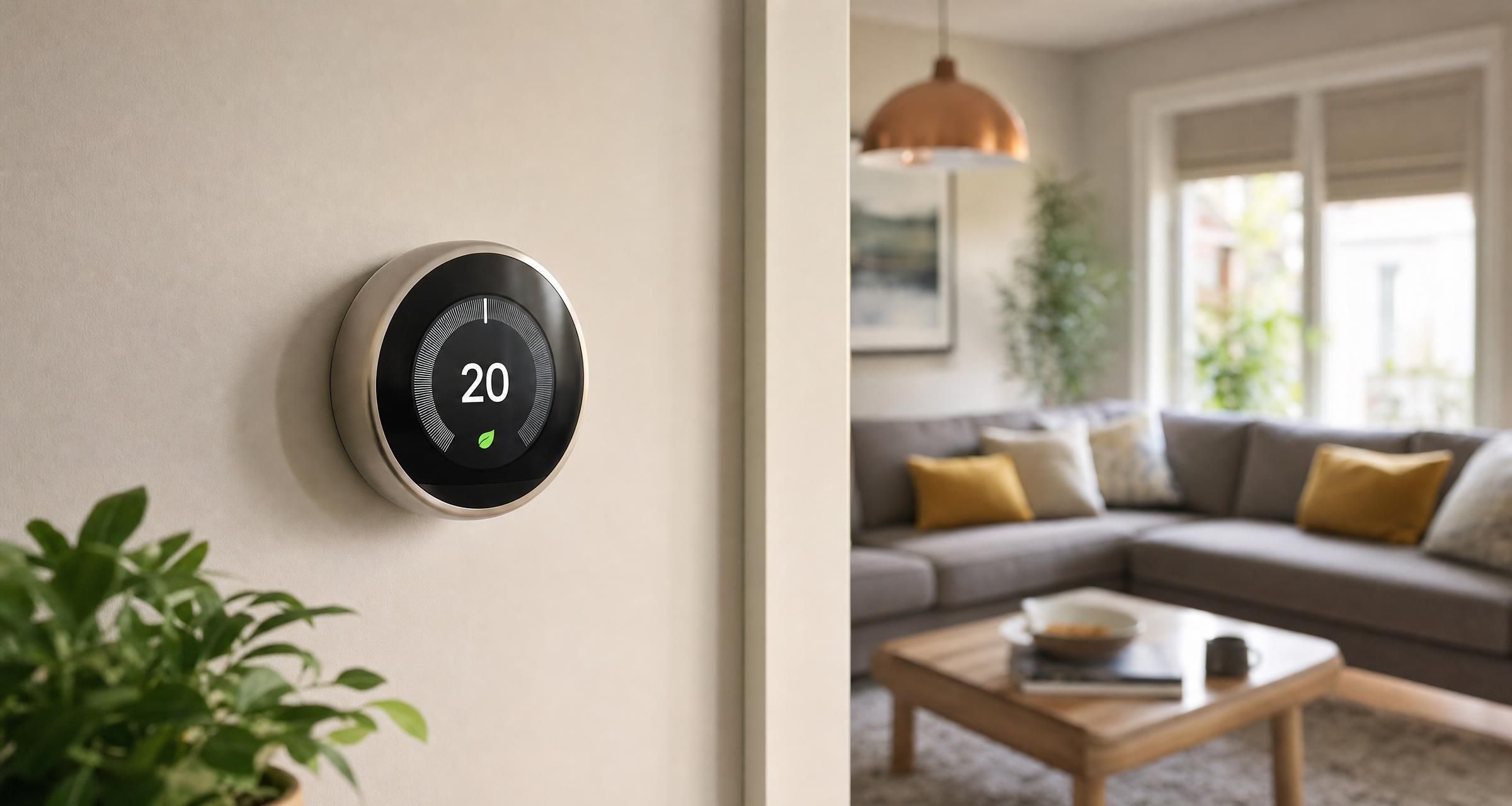
Smart Thermostat Installation Cost
The typical smart thermostat installation cost in the UK is £180 to £450 including a mid range thermostat and professional fitting. A straightforward replacement using existing wiring may cost as little as £120 to £220 in labour and materials, while a more involved installation with a receiver, wiring centre alterations, underfloor heating controls or multi zone heating can reach £500 to £900 or more.
The final price depends less on the thermostat itself than on your existing heating controls. A modern combi boiler with a suitable wall thermostat and receiver is usually simple. An older system with a hot water cylinder, separate programmer, pump, motorised valves and several heating zones needs more investigation before a tradesperson can give a reliable fixed price.
Smart controls can reduce wasted heating by learning routines, allowing remote adjustments and responding to occupancy or weather data. They are not a substitute for a well maintained boiler, decent insulation or correctly balanced radiators, but they can give homeowners better control over when and where heat is used.
For wider context on connected devices and compatibility in British homes, see Understanding Smart Home Technology in the UK Market.
Average smart thermostat installation cost in the UK
Most homeowners buy either a basic app controlled thermostat, a smart thermostat with a separate boiler receiver, or a zoned system with radiator valves and room sensors. The table below shows realistic supply and installation costs for a typical home in 2026.
| Type of installation | Typical equipment cost | Typical labour cost | Typical total cost | Likely timescale |
|---|---|---|---|---|
| Basic smart thermostat replacing an existing wired thermostat | £80 to £170 | £80 to £150 | £160 to £320 | 1 to 2 hours |
| Smart thermostat with wireless receiver for a combi boiler | £140 to £280 | £120 to £220 | £260 to £500 | 2 to 4 hours |
| Smart thermostat for a boiler and hot water cylinder system | £160 to £300 | £180 to £350 | £340 to £650 | 3 to 5 hours |
| Smart thermostat with smart radiator valves for 5 radiators | £300 to £600 | £150 to £300 | £450 to £900 | Half to one day |
| Multi zone heating, underfloor heating or complex control upgrade | £350 to £1,000 plus | £300 to £700 plus | £650 to £1,700 plus | One to two days |
London, the South East and some city centres often attract higher labour rates. Expect to pay at the upper end of the range where parking, congestion, restricted access or urgent attendance is involved. A rural property may have a lower hourly rate but a callout or travel charge.
Many electricians charge roughly £45 to £80 per hour outside London, or £70 to £120 per hour in London and high cost areas. Heating engineers commonly price control upgrades as a fixed job, particularly where boiler wiring and commissioning are included. For a clearer picture of labour pricing, read Electrician Hourly Rates.
What affects the price of fitting a smart thermostat?
Your existing heating system
A combi boiler provides heating and instant hot water, so the smart thermostat usually only needs to control central heating. This is the simplest setup. The engineer may replace an existing wired room thermostat, fit a receiver near the boiler, pair the wireless thermostat and test operation.
A conventional or system boiler with a hot water cylinder requires more careful configuration. The controls may need separate heating and hot water schedules, cylinder thermostat integration and correct operation of motorised valves. A smart thermostat that only supports heating control may not provide the full upgrade a homeowner expects.
Older gravity fed systems, systems with ageing wiring centres and installations with multiple valves can need fault finding before any smart control is fitted. If the existing controls are unreliable, fitting a new thermostat without resolving the underlying wiring fault can lead to heating that will not switch off, hot water that runs unexpectedly or a boiler that locks out.
Wired, wireless or digital boiler control
A wired thermostat can often use the existing cable. This keeps labour costs down, provided the cable is sound and reaches a suitable location. If a new cable must be routed through finished walls, floors or cupboards, costs rise quickly. Surface trunking is cheaper but less discreet.
A wireless thermostat normally uses a receiver wired beside the boiler. This avoids chasing walls, but the receiver still requires a safe permanent electrical connection and correct boiler terminals. It also needs a reliable radio signal between thermostat and receiver.
Some boilers support digital communication controls, which can modulate the boiler output rather than simply switch it on and off. These systems may improve comfort and efficiency, but only if the thermostat is compatible with the boiler manufacturer’s communication protocol. Compatibility should be checked against the exact boiler model, not assumed from the boiler brand alone.
Heating zones and smart radiator valves
A standard thermostat controls the whole heating circuit. Smart radiator valves can provide room by room scheduling, but they add equipment cost and need careful setup. A typical valve costs £45 to £75, with premium models costing more.
Do not fit smart valves to every radiator without considering system bypass requirements. Many systems need at least one radiator without a thermostatic valve, often in the bathroom, or a correctly installed automatic bypass valve. This ensures water can circulate safely if every smart valve closes while the boiler or pump is running.
Properties with separate upstairs and downstairs heating zones, extensions, annexes or underfloor heating may need more than one thermostat, dedicated zone valves or a compatible wiring centre. This is not a simple swap job.
Condition of the existing controls
Old programmers, corroded terminals, brittle cable insulation and poorly labelled wiring can turn a two hour installation into half a day of diagnostics. A professional will usually test the existing system before disconnecting anything. If the system has been altered several times over decades, the original wiring colours and terminal functions cannot be trusted without testing.
Allow a contingency of £100 to £250 if the controls are old and you have no recent evidence of proper operation. This is especially sensible in homes with an older hot water cylinder system or a boiler located in a loft, garage or outbuilding.
Smart thermostat product costs
Smart thermostat prices vary according to features, ecosystem compatibility, sensors and whether smart radiator valves are included. Entry level products generally offer app scheduling and remote temperature adjustment. Higher priced systems may include occupancy sensing, geolocation, energy reports, hot water control, voice assistant support and multiple room sensors.
- Entry level app controlled thermostat, £80 to £150.
- Popular wireless smart thermostat and receiver kit, £140 to £250.
- Premium smart thermostat with room sensor or hot water capability, £200 to £350.
- Smart radiator valve, £45 to £75 each.
- Additional room sensor, £35 to £70.
- Smart underfloor heating controller, £120 to £250 per zone.
- Boiler relay, wiring accessories, fused connection unit or enclosure, £20 to £100.
Buying the cheapest unit is not always good value. A thermostat must support your boiler type, your hot water arrangement and your preferred control method. Some products require a subscription for advanced energy services. Others work only with a particular smart home platform or need a separate hub. Check ongoing costs and broadband requirements before ordering.
Who should install a smart thermostat?
A competent electrician, heating engineer or Gas Safe registered heating engineer may install smart heating controls, depending on the job. The right choice depends on what is being altered.
If the work is limited to low voltage controls and electrical connections outside the boiler, an experienced electrician or heating controls specialist can often carry out the installation. If the work involves the boiler itself, especially removal of the combustion case or work that affects gas safety, use a suitably qualified Gas Safe registered engineer. Ask to see their Gas Safe ID card and check that their registration covers boilers.
Electrical work must be carried out safely. In England, electrical safety requirements are set through Part P of the Building Regulations. Replacing or adding heating controls is usually not notifiable work if it is outside special locations, but the installation must still comply with relevant electrical safety requirements. A qualified electrician should work to BS 7671, commonly known as the IET Wiring Regulations, and provide appropriate certification where required.
Electrical work in bathrooms, shower rooms and other special locations has additional restrictions. A thermostat should not be installed in an unsuitable bathroom location simply because it is convenient. The thermostat must also be positioned where it senses representative room temperature rather than steam, cold draughts or direct heat.
The Health and Safety Executive guidance on gas safety explains the legal importance of using competent, registered engineers for gas work. Landlords have separate statutory duties, including annual gas safety checks where gas appliances are provided.
Choosing the right smart thermostat for your home
Start with the boiler model and the type of system, not the appearance of the thermostat. Take a photograph of the boiler data badge, existing programmer, room thermostat and wiring centre before requesting quotes. This allows the installer to assess likely compatibility.
Ask whether the thermostat uses simple relay switching or digital modulation. Relay control will work with many boilers but may not use the boiler’s full modulation capability. A compatible modulating controller can reduce boiler cycling and maintain steadier temperatures, particularly in a well balanced system.
For homes with a hot water cylinder, confirm that the product controls domestic hot water independently. Some systems can run heating schedules but cannot replace a full programmer for stored hot water. Others can control both, but require correct configuration of the cylinder thermostat and valves.
For a useful overview of how room thermostats, timers and thermostatic radiator valves work together, see Boiler Controls Explained Thermostats Timers TRVs and Smart Heating Options.
Thermostat location matters
A smart thermostat placed in the wrong room will not save money. Avoid outside walls where possible, direct sunlight, kitchens, hallways with frequent external door use, fireplaces, radiators, televisions and areas affected by cooking. A typical location is an internal wall in a frequently occupied living area, around 1.2 to 1.5 metres above the floor.
Wireless models give more flexibility, but do not place them in a rarely used cold room. If the thermostat reads a lower temperature than the main living space, it will keep the boiler running longer than necessary. Room sensors may help in homes where the thermostat location cannot be improved.
What a professional smart thermostat installation should include
A proper installation is more than connecting two wires and downloading an app. The engineer should inspect the existing controls, isolate electrical supplies safely, identify terminals, fit the device securely and test heating operation through a full cycle.
- Confirm the boiler model, heating system type and thermostat compatibility.
- Inspect existing controller wiring, fused spur and boiler connections.
- Safely isolate electrical supplies before work begins.
- Install the thermostat, receiver, sensors or smart valves in suitable locations.
- Configure heating zones, hot water schedules and boiler control settings.
- Check that the boiler fires and stops correctly on demand.
- Test hot water operation where the property has a cylinder.
- Check that motorised valves open and close correctly where fitted.
- Pair the app, WiFi connection and any room sensors.
- Show the homeowner how to adjust schedules, set temperatures and use manual override.
Commissioning matters. The installer should verify that the heating does not remain permanently on after the thermostat reaches temperature. They should also make sure the boiler does not short cycle repeatedly, which may point to poor control settings, an oversized boiler, restricted circulation or a faulty bypass arrangement.
Common mistakes to avoid with smart thermostat installation
Assuming every smart thermostat fits every boiler
Many thermostats can provide basic on and off control, but that does not mean every advanced feature will work. A boiler may need a specific manufacturer controller for digital modulation. Fitting an incompatible product can result in basic heating operation only, loss of hot water scheduling or error codes.
Using existing wiring without testing it
Older thermostat cables can be damaged behind walls or connected differently at the boiler end. Never rely only on terminal labels or wire colours. A competent installer tests circuits and traces the controls wiring before making permanent changes.
Putting the thermostat in the coldest or hottest place
Hallways, kitchens and areas near external doors commonly produce misleading readings. A thermostat should reflect the temperature of the main occupied area. If the home has large open plan spaces, several room sensors or a zoned solution may be more suitable.
Turning every radiator valve into a smart valve
A fully closed system can restrict water flow and create boiler noise, pump strain or overheating issues. Keep a suitable bypass route and make sure the system has been designed to operate safely with multiple thermostatic valves.
Ignoring weak WiFi or poor signal range
A thermostat can still control heating locally if its internet connection drops, depending on the model, but app control and cloud features may fail. Test WiFi in the thermostat position and check radio range from the receiver to any remote sensors or valves. Thick masonry walls, foil backed insulation and boiler cupboards can reduce signal strength.
Replacing controls without checking radiator balancing
Smart controls cannot correct a system where upstairs rooms overheat, distant radiators stay cold or the boiler flow temperature is excessive. Before judging the new thermostat, make sure radiators are bled, thermostatic valves move freely and the system has been properly balanced.
Can you install a smart thermostat yourself?
Some battery powered smart thermostats are marketed as suitable for DIY fitting, particularly where they replace an existing unit using identical terminals. In practice, boiler controls are one of the most commonly miswired parts of a domestic heating system. A mistake can damage a boiler control board, blow a fuse, cause permanent heating demand or leave the home without heating and hot water.
DIY installation is lower risk where the system uses a plug in gateway and no fixed wiring changes are needed. It is higher risk where a receiver must be connected near the boiler, a wired thermostat is being moved or the property has a hot water cylinder and wiring centre.
If you are replacing a faulty thermostat, understand whether the fault is actually in the thermostat, receiver, wiring, boiler, programmer or zone valve before buying a replacement. This article may help you identify the scope of the job, How to Replace a Faulty Thermostat in a Home Safely and Correctly.
How to get an accurate quote
Good quotations are based on evidence, not assumptions. Send clear photographs of the boiler front, boiler data plate, existing room thermostat, programmer, cylinder controls and any wiring centre. Explain whether you have a combi boiler or a cylinder, whether you want hot water control and whether there are separate heating zones.
Ask the tradesperson to state whether the quote includes the thermostat, installation, electrical accessories, app setup, testing and disposal of old controls. If you have already purchased equipment, provide the exact make and model before booking. Some installers will fit customer supplied devices but may limit their warranty to workmanship rather than the product itself.
For complex systems, a site visit is worthwhile. It can prevent the common situation where an attractive remote quote rises after the installer finds incompatible wiring or a system that needs additional components.
FAQ
How much does it cost to replace an old thermostat with a smart thermostat?
Replacing an existing wired room thermostat with a compatible smart model normally costs £160 to £320 including the device and labour. If the thermostat is supplied by the homeowner and the existing cable is suitable, labour may be £80 to £150. Costs increase if the installer needs to add a boiler receiver, repair wiring, move the thermostat location or alter controls for a hot water cylinder.
Does a smart thermostat need an electrician or a heating engineer?
Either may be suitable for straightforward work, provided they are competent with domestic heating controls and the scope is within their qualifications. Use a Gas Safe registered engineer if work involves the boiler combustion case, gas carrying components or boiler commissioning tasks that require gas competence. Use an electrician experienced in heating controls where fixed electrical wiring, circuit protection or fault finding is the main issue.
Will a smart thermostat work with an old boiler?
Usually, yes, for basic heating on and off control, provided the boiler and control circuit are in safe working order. However, an old boiler may not support digital modulation, app based hot water scheduling or advanced efficiency functions. Older control wiring and failing motorised valves can also create installation issues. A professional compatibility check is sensible before buying equipment.
Do smart thermostats actually reduce heating bills?
They can reduce consumption where they replace poor heating habits, such as heating an empty home, running the boiler at unnecessarily high temperatures or using one schedule for every room. Savings vary greatly with insulation, occupancy, boiler efficiency and existing controls. Do not expect large savings if you already use a well programmed thermostat, sensible radiator valve settings and an efficient boiler.
Do I need planning permission or Building Regulations approval?
Planning permission is not normally required for a smart thermostat installation. Building Regulations notification is also not usually required for a simple controls replacement outside special locations in England. The electrical and heating work must still be safe and compliant. Larger alterations, new circuits, work in bathrooms or changes associated with major heating upgrades may have additional requirements, so ask the installer to confirm the position for your property and location.
Final Thoughts
A smart thermostat is a worthwhile upgrade where it is compatible with the boiler, correctly located and properly commissioned. Budget £180 to £450 for most standard installations, but allow more for hot water cylinders, old controls, multiple zones and room by room smart radiator valve systems. The best result comes from matching the controls to the heating system rather than choosing a thermostat solely on app features.
If you want clear local prices and a qualified professional to assess compatibility, post a job on BookaBuilderUK to get free quotes from vetted local tradespeople.


